FRAC
For every government position, there are roles; each role has activities associated with it; accomplishing each activity needs certain competencies. FRAC will map the roles and activities corresponding to every government position with their desired competencies. This is depicted in the figure below –
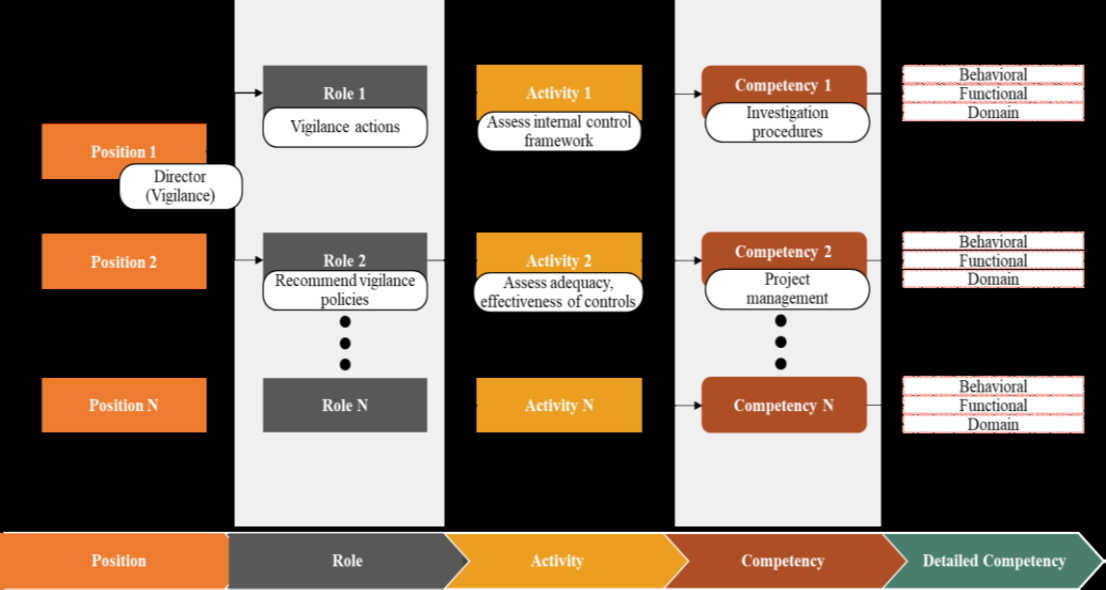
Competencies encompass behavioural attributes, functional skills, and domain knowledge, which are required in an individual for effective performance.
- Behavioural competencies are a higher order of behaviours that are applicable across a range of jobs, functions, and roles, within the organisation. They describe the key values and strengths that help a department/organisation/official perform effectively in a range of jobs.
- Functional competencies describe the application of knowledge and skills needed to perform effectively in a specific role or group of jobs. They may also include job specific competencies that define the skills and knowledge needed to perform a specific role effectively.
- Domain competencies are shared by a ‘family’ of related jobs that have common functions and form a logical career path. These competencies are defined for a specific department or business unit, but it may also define jobs across departments that share common tasks and functions.
A competency will have multiple levels of proficiency, organised in a stepped manner depicting gradual progression from one level to the other. As civil service officials progress in their career, it is desirable that they gain new competencies and evolve their proficiency in their current competencies. FRAC, will classify proficiencies for each competency in 5 levels – from Beginner to Expert. Traditionally, proficiency levels are linked to hierarchical level but with FRAC, the professional working context will determine the proficiency level that is expected. For instance, a Director in the Ministry of Finance may require Level 1 proficiency in human resource management, whereby an Under Secretary in DoPT may require Level 4 proficiencies.
By design, FRAC will ensure development of a comprehensive, shared, and consolidated repository of competency information, accessible to all relevant stakeholders. The framework will define, in generic terms, the tasks that are performed for a role, the corresponding desired traits, behaviours, knowledge and skills, and the reference documents that detail how the activity should be performed. This common shared language of FRAC will also enable vertical integration of operations, which will align the strategy of the government to individuals and their competencies; and horizontal integration with tight coupling of human resource management processes- from recruitment to reward.